

Image Details
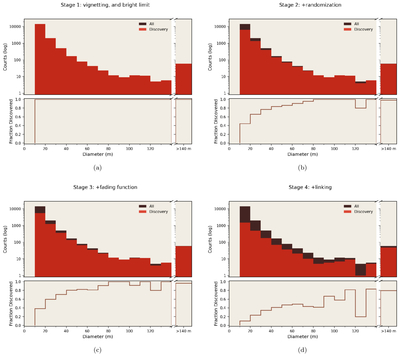
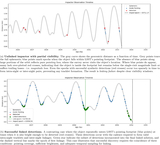
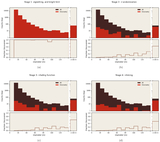
Caption: Figure 9.
Successive application of Sorcha’s survey-simulation filters and their impact on LSST impactor discovery. Each panel shows the differential size distribution (top) and the discovered-to-total ratio (bottom) as a function of the impactor diameter. (a) Stage 1 includes only single-exposure photometric modeling (trailed magnitude, vignetting, bright limit), isolating per-visit detectability. (b) Stage 2 adds photometric randomization, introducing realistic pointing history and sky coverage. (c) Stage 3 enables the source-detection efficiency (“fading”) function, which probabilistically removes marginal detections near the limiting magnitude. (d) Stage 4 activates the linking filter, requiring detections to form valid tracklets and tracks to be classified as discoveries. Together, the panels show how progressively enabling Sorcha filters transforms single-visit detectability into end-to-end survey discovery efficiency.
Other Images in This Article
Copyright and Terms & Conditions
© 2026. The Author(s). Published by the American Astronomical Society.

