

Image Details
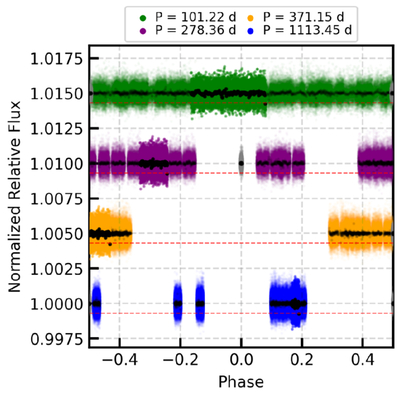
Caption: Figure 6.
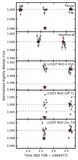
Building on the work from S. Sulis et al. (2024), we plot all TESS sectors that have targeted HIP 41378 (7, 34, 44, 45, 46, 61, 72, and 88) binned to 3 hr and phase-folded to the four possible orbital periods for HIP 41378 d (P = 101.2224 days in green, P = 278.3616 days in purple, P = 371.1488 days in yellow, and P = 1113.4465 days in blue). Unbinned data are shown as small semi-transparent points, with TESS Sector 88 data (higher opacity) highlighting the new observations that enable us to rule out the 101 days solution. Binned data are shown as larger black points. The red dashed lines indicate the expected transit depth of HIP 41378 d (0.67 ppt, J. C. Becker et al. 2019). The 101 days solution is inconsistent with the TESS data at 7.2σ confidence. Gray points show 38 s CHEOPS data from S. Sulis et al. (2024).
Other Images in This Article
Copyright and Terms & Conditions
© 2026. The Author(s). Published by the American Astronomical Society.

