

Image Details
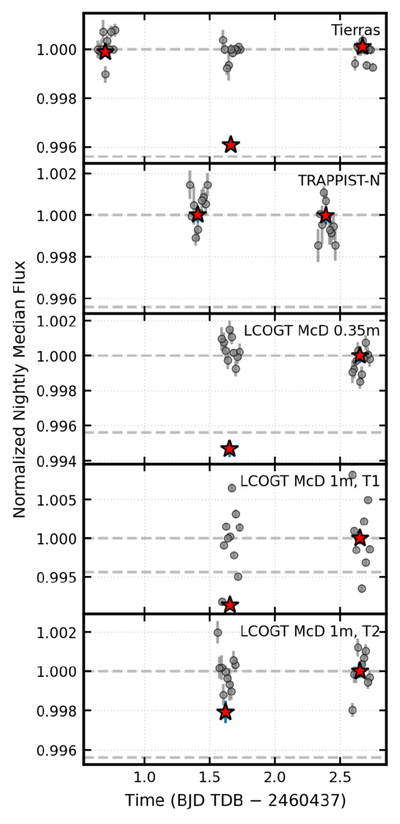
Caption: Figure 4.
Normalized nightly median flux of the 10 highest-weighted reference stars (gray circles) compared to HIP 41378 (red star) for all multi-night facilities. Reference stars are shown in uniform gray; different stars with facility-specific weights are used for each telescope. Points are offset horizontally for clarity. The 10 stars represent 63%, 98%, 48%, 61%, and 51% of the ELC weight for Tierras, TRAPPIST-North, McD 0.35 m, McD 1.0 m T1, and McD 1.0 m T2, respectively. Dashed lines mark unity and the 4.4 ppt expected transit depth. Tierras and McD 0.35 m show stable reference stars with HIP 41378 exhibiting 3.9 ppt and 5.3 ppt flux decrements on UTC 2024 May 8 (SNR = 10σ and 4.8σ). TRAPPIST-North is flat on both bracketing nights (1.12 ppt scatter, SNR = 3.9σ). McD 1.0 m T1 exhibits 5.55 ppt reference star scatter exceeding the transit depth (SNR = 0.8σ). McD 1.0 m T2’s observing sequence was interrupted after 1.6 hr on the in-transit night (Table 1), providing inadequate baseline characterization. Both McD 1.0 m datasets are excluded from the transit fit.
Other Images in This Article
Copyright and Terms & Conditions
© 2026. The Author(s). Published by the American Astronomical Society.

