

Image Details
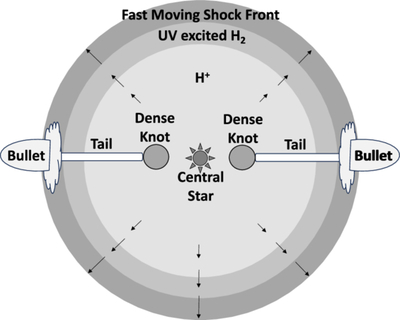
Caption: Figure 10.
Schematic of the scenario presented in Section 7.2 of converging conical shocks within a PN. Here a fast-moving planar shock front passes through the nebula. When encountering slower-moving dense knots, the shock front diffracts around those knots and forms cone-shaped cavities between the shock front and the knots. The cavities collapse on themselves as converging conical shocks. If cooling is efficient, this forms dense bullets at the fast-moving shock front followed by dense tails behind the bullets leading back toward the knots. The molecular gas in the bullets would be shock-heated, and the H2 would emit a thermal spectrum. UV-excited H2 emission might arise from the inside of the shock front. Like the bipolar outflow scenario, the tails closer to the central star could become dissociated and photoionized, giving rise to [Fe II] and [Fe III] emission. In this scenario, the line of sight of our observations would be along the major axis of the bullet and tail structures (viewed from the right or left as depicted in this figure).
Other Images in This Article
Copyright and Terms & Conditions
© 2026. The Author(s). Published by the American Astronomical Society.

