

Image Details
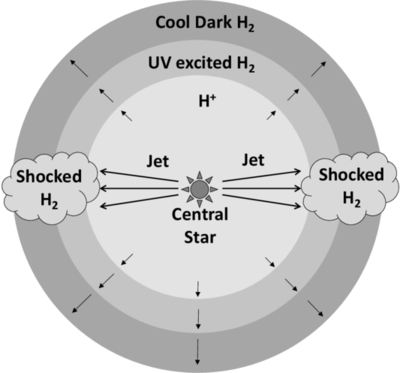
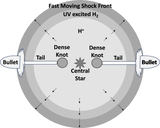
Caption: Figure 9.
Schematic of the scenario presented in Section 7.1 of a shocked collimated bipolar outflow within a PN. Here we show the excitation structure of the nebula with an ionized center consisting mainly of H+, molecular gas surrounding the ionized gas where H2 can absorb FUV photons from the central star that make it through the ionized zone and become excited, and any cool molecular gas that might exist in the outermost regions of the nebula, which consists of mostly nonemitting H2. These layers are all slowly expanding away from the central star, as shown with the short arrows. A fast-moving collimated jet from the central star, shown with the long arrows, passes through the ionized zone and collides with the outer molecular layers of the nebula, shocking H2 swept up there or H2 that was in the ends of the jets themselves, which we see as the thermal H2 bullets. In this scenario, the line-of-sight of our observations would be along the major axis of the jet (viewed from the right or left as depicted in this figure).
Other Images in This Article
Copyright and Terms & Conditions
© 2026. The Author(s). Published by the American Astronomical Society.

