

Image Details
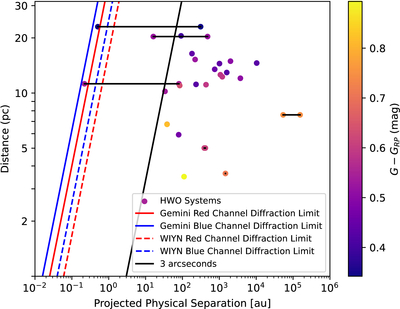
Caption: Figure 5.
Distances to the 27 multistar systems identified in this study as a function of projected physical separation. The solid red and blue lines represent the nominal diffraction limits for the 562 nm (blue) and 832 nm (red) filters installed in ‘Alopeke and Zorro. The dashed lines represent the same for NESSI. The black line is the 3″ cut used in the original sample selection for the ExEP provisional star list for HWO. The color of the points highlights the G − GRP values of the stars. If the system is triple, then it has two points representing the AB and AC components, and we connect these systems by the black horizontal lines. We assume the primary’s distance as the distance for the system. The majority of the stellar companions lie beyond 3″, which shows that the selection criteria from E. Mamajek & K. Stapelfeldt (2024) removed most close-in multiples from the sample. However, some systems are still found with separations less than 3″, which highlights the need for a uniform multiplicity study of all the potential HWO target stars.
Other Images in This Article
Copyright and Terms & Conditions
© 2026. The Author(s). Published by the American Astronomical Society.

