

Image Details
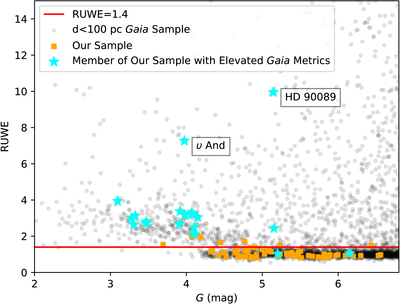
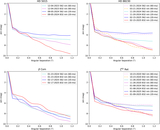
Caption: Figure 4.
RUWE values of the 80 HWO targets surveyed in this work as a function of Gaia G magnitude. Cyan stars indicate the 19 stars that were flagged as potential binaries by our Gaia metric criteria, while the remaining 61 stars are shown as orange squares. The red line indicates a RUWE value of 1.4, which is the value typically used to distinguish single and nonsingle stars. The black points represent a sample of stars within 100 pc from Gaia DR3. We label the two stars with RUWE > 7. As one goes to brighter magnitudes, the RUWE values rise, which could indicate the presence of unresolved companions. However, it is more likely that the brightness of these targets is increasing the astrometric errors. As such, the RUWE value may not be the best indicator of stellar multiplicity for stars brighter than G ∼ 4.5 mag.
Other Images in This Article
Copyright and Terms & Conditions
© 2026. The Author(s). Published by the American Astronomical Society.

