

Image Details
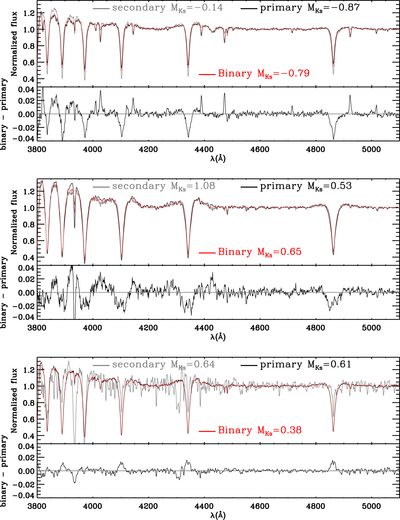
Caption: Figure 16.
A few typical examples of mock composite spectra. We focus on the wavelength range of λ3800–5100 Å. The spectra of the primary, secondary, and binary are shown in black, gray, and red, respectively. For all these cases, the primary is a B-type star. The secondary are B-, A- and G-type stars from the top to bottom, respectively. The spectroscopic ﹩{M}_{K{\rm{s}}}﹩ estimates applied to the primary, secondary, and composite binary spectra are also shown in the figure. The spectroscopic ﹩{M}_{K{\rm{s}}}﹩ estimate of the binary spectra typically agrees with the one from the primary spectra, with a difference ≲0.2 mag.
Other Images in This Article
Show More
Copyright and Terms & Conditions
© 2021. The Author(s). Published by the American Astronomical Society.

