

Image Details
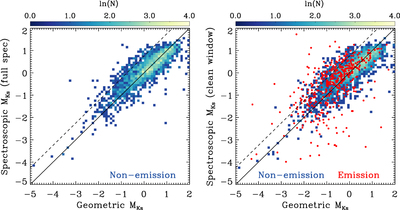
Caption: Figure 5.
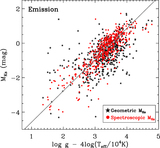
Comparison between the geometric ﹩{M}_{K{\rm{s}}}﹩ inferred from Gaia parallaxes and the spectroscopic ﹩{M}_{K{\rm{s}}}﹩ derived from LAMOST spectra for test stars. We only show results for test stars that have precise Gaia parallax measurements (﹩\varpi /{\sigma }_{\varpi }\gt 10﹩). The left panel demonstrates the spectroscopic ﹩{M}_{K{\rm{s}}}﹩ derived from the full spectrum for stars without emission lines. The right panel illustrates the spectroscopic ﹩{M}_{K{\rm{s}}}﹩ derived using only wavelength pixels that are devoid of emission lines for both non-emission stars (blue/green background) and emission-line stars (red dots). In both panels, the solid line delineates the one-to-one line. The dashed line shows an offset of 0.75 mag from the one-to-one line, the offset one would expect from equal-mass binaries. Stars that are close to the dashed line have geometric ﹩{M}_{K{\rm{s}}}﹩ brighter than the spectroscopic ﹩{M}_{K{\rm{s}}}﹩, signaling the possibility of binaries or multiple systems.
Other Images in This Article
Show More
Copyright and Terms & Conditions
© 2021. The Author(s). Published by the American Astronomical Society.

