

Image Details
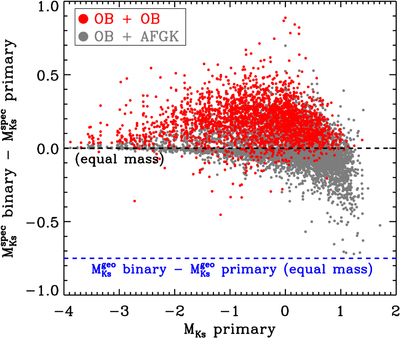
Caption: Figure 9.
Differences between the spectroscopic ﹩{M}_{K{\rm{s}}}﹩ estimates derived from mock composite binary spectra vs. those for the primaries of the composites. Red symbols show OB+OB binary systems and the gray symbols are binary systems composed of an OB star and a companion with another (AFGK) spectral type. In most cases, the composite spectra cause the inferred spectroscopic ﹩{M}_{K{\rm{s}}}﹩ to be slightly fainter than the primary, further facilitating the identification of binaries through the difference between geometric ﹩{M}_{K{\rm{s}}}﹩ and spectroscopic ﹩{M}_{K{\rm{s}}}﹩. For example, the geometric ﹩{M}_{K{\rm{s}}}﹩ for equal-mass binaries are 0.75 mag brighter than their primaries (dashed line in blue), due to the contribution from the secondary. We note that for some binaries composed of a late-B type primary with ﹩{M}_{K{\rm{s}}}\gtrsim 0.5﹩ mag and an AFGK-type secondary, the spectroscopic ﹩{M}_{K{\rm{s}}}﹩ could be brighter than that of the primary. As such, the binary identification in this regime is less efficient (see text for details).
Other Images in This Article
Show More
Copyright and Terms & Conditions
© 2021. The Author(s). Published by the American Astronomical Society.

