

Image Details
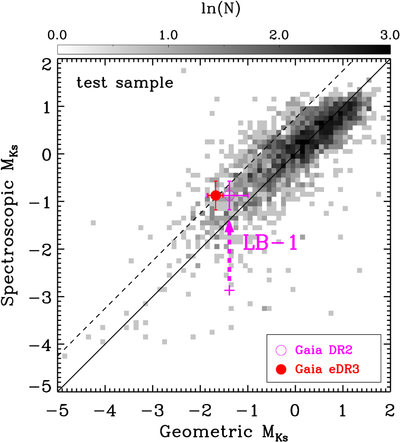
Caption: Figure 13.
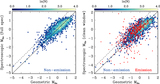
Comparison of spectroscopic ﹩{M}_{K{\rm{s}}}﹩ with geometric ﹩{M}_{K{\rm{s}}}﹩ for a test star sample with precise Gaia parallax (﹩\widetilde{\omega }/{\sigma }_{\widetilde{\omega }}\gt 10﹩). The solid line delineates the one-to-one line, while the dashed line delineates an offset of 0.75 mag to the one-to-one line. The inferred spectroscopic ﹩{M}_{K{\rm{s}}}﹩ and geometric ﹩{M}_{K{\rm{s}}}﹩ of the LB-1 system are highlighted by the pink circle with error bars. The plus symbol in pink shows the ﹩{M}_{K{\rm{s}}}﹩ (−2.9 mag) inferred from the distance in Liu et al. (2019a), which is at odds with our spectroscopic ﹩{M}_{K{\rm{s}}}﹩. The red dot with error bars shows the LB-1 geometric ﹩{M}_{K{\rm{s}}}﹩ based on the Gaia eDR3 parallax, which has a significantly smaller error bar compared to the Gaia DR2 result. It shows that LB-1 is a binary system, for which the component stars are comparably bright.
Other Images in This Article
Show More
Copyright and Terms & Conditions
© 2021. The Author(s). Published by the American Astronomical Society.

