

Image Details
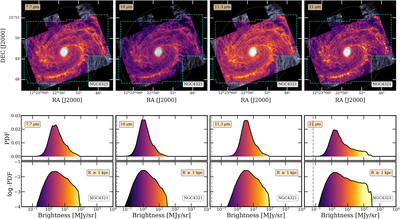
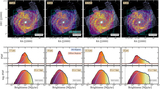
Caption: Figure 3.
The PDFs of emission of the galactic disk (r ≥ 1 kpc) after masking the center, at 7.7, 10, 11.3, and 21 μm for NGC 4321. Top: images of the galactic disk of NGC 4321 in each MIRI filter, with the masked central region shaded. Middle: PDFs of inclination-corrected intensity from each image excluding the masked central region. The colors in the PDF reflect the color bar in intensity used to display each image. Vertical dashed lines indicate rms noise levels in each filter. Bottom: the same disk-only PDFs shown in the middle row, but now with the y-axis in log-stretch to highlight features at the high-intensity end. The PDFs of the disk show a consistent lognormal component that peaks at lower intensities, as well as a high-intensity tail that can be roughly approximated to a power law.
Other Images in This Article
Show More
Copyright and Terms & Conditions
© 2023. The Author(s). Published by the American Astronomical Society.

