

Image Details
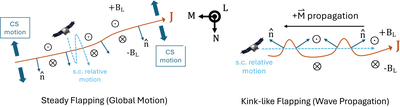
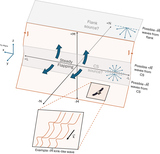
Caption: Figure 1.
Schematic of magnetotail flapping types observed in the current sheet (CS), adapted from G. A. DiBraccio et al. (2017) and C. Zhang et al. (2023). LMN coordinates are determined from MVA (see Sections 2 and 3.2). Current direction is the orange line (J), and oppositely directed lobe fields are ±BL. Left: example of steady flapping; the CS normals (﹩\hat{n}﹩) are steady in the M–N plane. The steady flapping is the back-and-forth global motion of the CS. Right: example of kink-like flapping; the CS normals (﹩\hat{n}﹩) are alternating in the M–N plane. The kink-like flapping is wave propagation along the CS moving across the spacecraft, in this example, +M propagation. In both cases, the spacecraft velocity is much slower than the flapping and is therefore considered as approximately stationary. Other geometries are possible but not shown here. Steady flapping is indicated by steady normals in the L–N plane. Kink-like flapping may have ±M propagation indicated by alternating normals in the M–N plane or ±L propagation indicated by alternating normals in the L–N plane, determined by the method from Z. Rong et al. (2015b) and extension by S. B. Xu et al. (2025).
Other Images in This Article
Show More
Copyright and Terms & Conditions
© 2026. The Author(s). Published by the American Astronomical Society.

