

Image Details
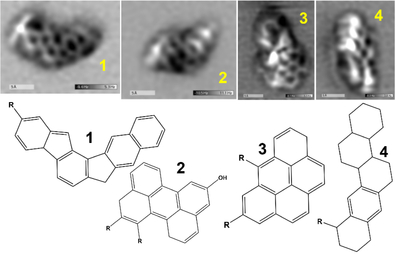
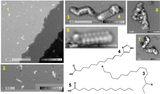
Caption: Figure C2.
Supplemental HR-AFM images with proposed molecular structures from the acetone extract of the Murchison meteorite are shown. Four additional images are presented, containing structures similar to those discussed in the main article (Figure 10), obtained from the same extract. The light gray scale bar shown on the left in each image corresponds to 5 Å. The image contrast represents the frequency shift (typical range: −10 Hz, …, +5 Hz), where brighter (more positive shift) indicates more repulsive tip-sample interactions, and darker (more negative shift) indicates more attractive interactions with the CO-functionalized tip. The –R side groups may include –H, –CH3, –OH, –NH, and –NH2, among others. While the core structures are well resolved, uncertainty remains in the assignment of nonplanar side groups at the molecular edges, which often appear very bright due to their position partially out of the molecular plane. Very dark edge regions (closer to the substrate) are typically associated with radical sites (e.g., missing hydrogen atoms).
Other Images in This Article
Show More
Copyright and Terms & Conditions
© 2026. The Author(s). Published by the American Astronomical Society.

