

Image Details
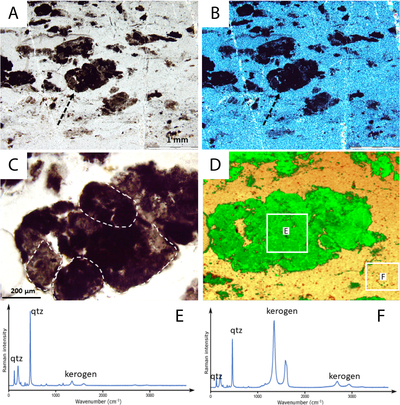
Caption: Figure C4.
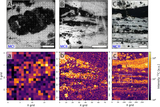
The context and details of clast in Figures 5(F) and 7(A) within a heterogeneous mass of pseudomorphed volcanoclastic material and carbonaceous matter (CM). (A), (B) Plane and polarized light micrographs of the sediment showing that the fine-grained sediment (now microcrystalline quartz, hereafter qtz, = chert) and the large carbonaceous clot are silicified. (C), (D) An optical micrograph and Raman spectral map with qtz in yellow/brownish (= area of the 465 cm−1 qtz band) and the carbonaceous matter in green (= area of the 1350 cm−1 CM D1 band) showing detail of target clot illustrating its composite nature, formed of a number of particles (outlined by a dotted white line) linked by carbonaceous matter. (E), (F) Average Raman spectra of the areas displayed in (D) showing the Raman bands of qtz at 126, 204, 260, 354, 397, 465, 697, 807, 1081, and 1162 cm−1, and the D1 at 1350 cm−1, the G+D2 at 1600 cm−1, the S1 at 2689 cm−1, and the S2 at 2939 cm−1, first- and second-order Raman bands of kerogen. This particle is probably detrital in origin, but sourced from the immediate environment. Delicate, organic-coated composite particles such as this would not have survived transport. Note that these sediments were deposited in a very shallow water regime, close to the shore, and influenced by wind/wave action, as well as, at times, tidal action (F. Westall et al. 2015b, 2026, in preparation).
Other Images in This Article
Show More
Copyright and Terms & Conditions
© 2026. The Author(s). Published by the American Astronomical Society.

