

Image Details
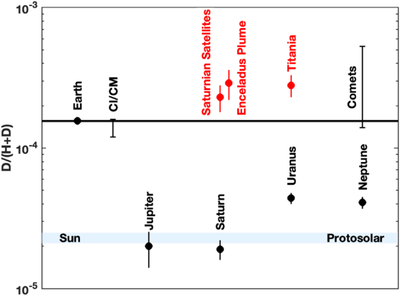
Caption: Figure 15.
Deuterium abundances across objects in the solar system. Our measurement of D/(H+D) for Titania, the average and standard deviation of twelve different D/(H+D) measurements for seven different Saturnian satellites by M. E. Brown et al. (2025), and Enceladus plume measurements by J. H. Waite et al. (2009) are plotted in red and show less scatter than that of comets, suggesting a more homogeneous reservoir for water in forming outer-planet satellites than in forming comets. Values for the Sun/protosolar nebula are from J. Geiss & G. Gloeckler (1998); values for the Earth are from H. Craig (1961); values for carbonaceous chondrites (CI/CM) are from C. M. O. Alexander et al. (2012); values for Jupiter are an average from P. R. Mahaffy et al. (1998), C. Gapp et al. (2024), and H. Wiesemeyer et al. (2024); values for Saturn are an average from L. N. Fletcher et al. (2009) and J. D. R. Pierel et al. (2017); values for Uranus and Neptune are from H. Feuchtgruber et al. (2013); the range of values for comets are from K. Altwegg et al. (2019), and references therein.
Other Images in This Article
Show More
Copyright and Terms & Conditions
© 2026. The Author(s). Published by the American Astronomical Society.

