

Image Details
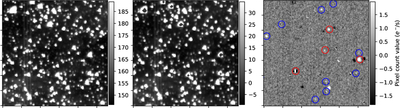
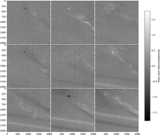
Caption: Figure 2.
Same as the upper left, lower left, and lower right panels of Figure 1, but zoomed in on a 140 × 140 pixel (49′ × 49′) area that includes four synthetic objects as well as nine real solar system objects. The synthetic and real objects are highlighted with red and blue circles, respectively, in the right panel. Note that for slow-moving objects, the donut template subtraction (Sections 5 and 6) causes negative “ears” on both sides of the object. The inner hole radius h and dough width d of the donut thus determines whether the donut subtraction subtracts a signal from the object, setting a lower rate limit on detectability. The real solar system objects were located using the mpchecker module of the jorbit Python package (B. Cassese et al. 2025); 29 real solar system objects were found to fall within the field of view, but only the brightest 9 have been circled, as even the faintest of 2–3 of those are hardly visible even when blinking a series of images. Here, only synthetic sources bright enough to be visible have been circled. The brightest two sources are also visible by eye in many of the uncleaned images, while all the fainter objects are either not visible or only visible when they are in fortunate locations far from background sources. The real solar system objects have not been labeled directly in the figure to avoid clutter, but going in clockwise order from the bright object in the top left, their IAU designation and jorbit estimated V-band magnitudes are (61067) 2000 LQ6, V ∼ 17.6; (335949) 2007 TF91, V ∼ 19.7; (66317) 1999 JL50, V ∼ 18.4; (568762) 2004 SM52, V ∼ 19.8; (147621) 2004 HD20, V ∼ 19.6; (79159) 1993 FP17, V ∼ 19.2; (426932) 2013 XL11 V ∼ 19.6; (14757) 6309 P-L, V ∼ 19.0; and (176,778) 2002 RF242, V ∼ 19.2. Pixel values are in electrons per second. The color scale for each panel was chosen using the common “z-scale” method.
Other Images in This Article
Copyright and Terms & Conditions
© 2026. The Author(s). Published by the American Astronomical Society.

