

Image Details
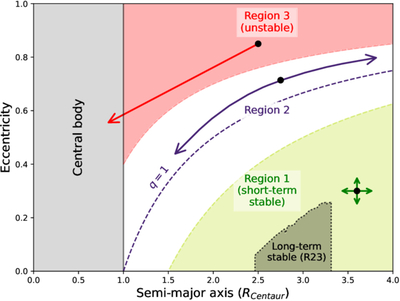
Caption: Figure 10.
This cartoon qualitatively explains the general process by which the ellipsoidal Centaur alters the ejected regolith (black dot) orbits in a−e space. The purple dashed line denotes an orbit with a pericenter of q = 1 RCentaur. Regolith particles with orbits of q ≤ 1 RCentaur or a ≤ 1 RCentaur (gray region) crash into the Centaur and are removed from the system. Region 1 (green) is our short-term stable region with q > 1 RCentaur where particles hover around their initial orbit (up to 100 orbits). We have overlaid the more restricted and long-term stable region (up to ∼10,000 orbits) around Chariklo from T. Ribeiro et al. (2023). Region 2 (white between the green and red regions) is a quasistable region with particles shuttling back and forth due to angular momentum transfer from the ellipsoidal Centaur. Region 3 (red) is an unstable region with q < 1 RCentaur where particles are pulled in toward, and eventually crash into the Centaur. Ejected regolith particles typically have initial orbits with high e and low a, near Region 2 and 3. The ellipsoidal Centaur initially “pulls down” regolith close to/under the q = 1 RCentaur curve. Regolith particles are brought closer together, increasing the likelihood of collisions. Subsequent collisions between regolith particles also damp their orbits, transfer them into the stable regions (region 1 and 2), and aid capture into orbit. All lines drawn are approximate.
Other Images in This Article
Copyright and Terms & Conditions
© 2026. The Author(s). Published by the American Astronomical Society.

