

Image Details
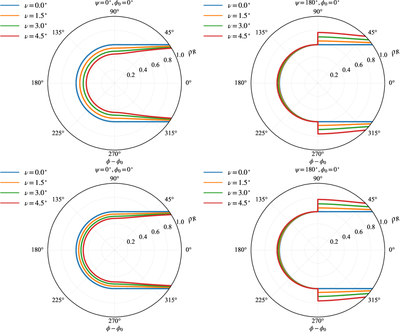
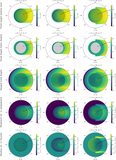
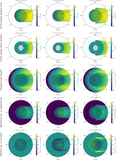
Caption: Figure 5.
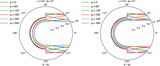
Shadow condition (Equation (28)) shown for muons with different normalized impact distances ρR, at fixed impact angle ϕ0, for the parameters of an SCT. The top panels neglect the effects of the M2 baffles, while the bottom panels include their contribution using Equation (32). A Cherenkov angle of 1﹩\mathop{.}\limits^{^\circ }﹩3 is assumed. The region enclosed by the colored curves corresponds to trajectories experiencing shadowing along the muon path. Different muon-impact points have been simulated located on a line connecting the center with leftmost part of the outer ring, corresponding to ρR = 1. The radial axis ρR denotes the impact distance on that line. The azimuthal axis represents the photon emission angle (ϕ − ϕ0). By convention, (ϕ − ϕ0 = 0°) corresponds to the longest chord on the mirror; photons emitted in that direction are always shadowed, as they propagate toward the mirror center and thus toward the secondary mirror. Photons emitted in the opposite direction are shadowed only until the muon reaches Rshadow. In the left-hand panel, the muon is inclined toward the left with varying inclination angles ν; in the right-hand panel, it is inclined toward the right. Sharp transitions are visible at (ϕ − ϕ0 = 90°) and (ϕ − ϕ0 = 270°) when the muon is inclined toward the secondary mirror, along with a slight increase of Rshadow for all directions of (ϕ − ϕ0).
Other Images in This Article
Copyright and Terms & Conditions
© 2026. The Author(s). Published by the American Astronomical Society.

