

Image Details
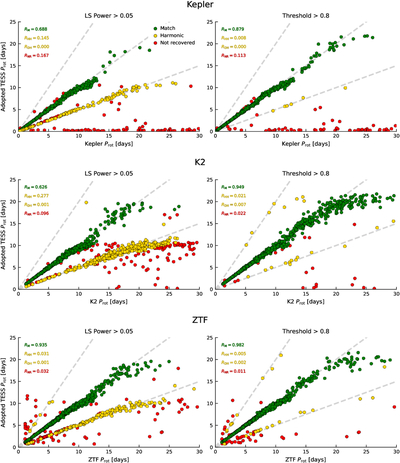
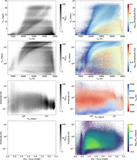
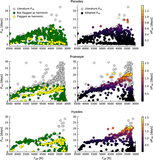
Caption: Figure 6.
Validation of our vetting procedure using Kepler, K2, and the Zwicky Transient Facility (ZTF). Top: Kepler comparison to A. McQuillan et al. (2014). Middle: K2 comparison to T. Reinhold & S. Hekker (2020). Bottom: ZTF comparison to Y. L. Lu et al. (2022). Each panel lists the rates of matches (RM), half-period harmonics (RHH), double-period harmonics (RDH), and nonrecoveries (RNR). The left panels show a baseline approach adopting the highest Lomb–Scargle peak (L-S power >0.05). Green points denote 3σ matches, yellow indicates harmonics, and red shows nonrecoveries; a prominent half-period harmonic sequence is evident in all surveys. The right panels show results after applying our full vetting procedure, including systematics and harmonic random forest classifiers and all quality flags. The half-period sequence is largely reduced, yielding agreement across a broad period range. Residual discrepancies are dominated by unidentified harmonics (0.8% in Kepler, 2% in K2, 0.5% in ZTF) and doubled periods (0% in Kepler, 0.7% in K2, 0.2% in ZTF). Overall, the method reliably recovers rotation periods out to Prot ∼ 25 days, beyond the typical single-sector TESS limit.
Other Images in This Article
Show More
Copyright and Terms & Conditions
© 2026. The Author(s). Published by the American Astronomical Society.

