

Image Details
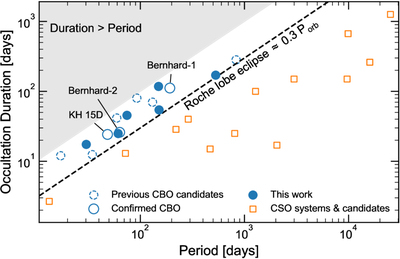
Caption: Figure 8.
Occultation duration versus orbital period for currently known CBO and CSO systems and candidates. Blue circles represent CBO systems: filled circles denote the six new candidates from this work, while solid and dashed circles correspond to confirmed and previously reported candidates, respectively. Orange squares indicate CSO systems, where occultation arises from material surrounding a companion. For KH 15D, we adopt a representative occultation duration of half the orbital period. The black dashed line indicates the theoretical maximum duration for an occultation induced by a Roche-lobe-filling disk around an equal-mass companion in a circular orbit (Equation (5)). The shaded region indicates the unphysical regime where the occultation duration exceeds the orbital period. All CBO and CSO systems lie above and below the threshold, with median orbital periods of ∼74 days and ∼1277 days, respectively.
Other Images in This Article
Show More
Copyright and Terms & Conditions
© 2026. The Author(s). Published by the American Astronomical Society.

