

Image Details
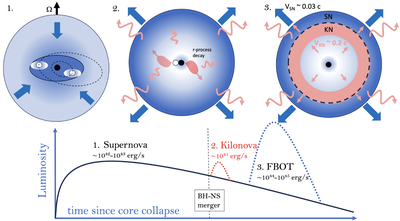
Caption: Figure 6.
Schematic timeline of a delayed compact-object merger embedded inside the ejecta of a preceding stripped-envelope supernova. Left: core collapse forms a central BH surrounded by a massive, fragmenting accretion disk. One or more disk fragments collapse into compact objects and undergo gravitational scattering in the potential of the central BH. Middle: after a delay tm, one compact object merges with the BH inside the expanding supernova ejecta. If the NS is tidally disrupted, the merger launches neutron-rich ejecta of mass MKN and velocity vKN, whose radioactive r-process heating can be reprocessed by the overlying supernova material. Right: the faster merger ejecta catch up with the slower inner supernova ejecta, moving at characteristic velocity ﹩{v}_{{\rm{SN}}}﹩, after a time ﹩{t}_{{\rm{coll}}}\simeq {v}_{{\rm{SN}}}{t}_{{\rm{m}}}/({v}_{{\rm{KN}}}-{v}_{{\rm{SN}}})﹩. Thermalization of the kilonova-ejecta kinetic energy, ﹩{E}_{{\rm{KN}}}\simeq {M}_{{\rm{KN}}}{v}_{{\rm{KN}}}^{2}/2﹩, can power a luminous shock-powered optical flare on a timescale set by the larger of the photon diffusion time through the supernova ejecta and the light-crossing time of the interaction radius. Depending on the merger delay and ejecta parameters, the observable counterpart may appear as a late-time kilonova-powered excess or as an FBOT-like flare near the GW event.
Other Images in This Article
Copyright and Terms & Conditions
© 2026. The Author(s). Published by the American Astronomical Society.

