

Image Details
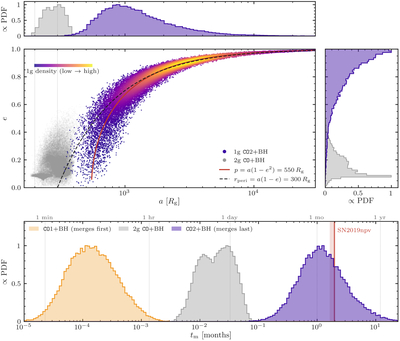
Caption: Figure 3.
Top panels: joint distribution of post-first-event semimajor axis a and eccentricity e, with marginal histograms. The surviving outer companion (1g CO2 +BH; colored density) traces a high-eccentricity, large-a ridge with e → 1 and a ∼ 103–104 Rg, while the second-generation product (2g CO +BH; gray) clusters at a ≲ few ×102 Rg with modest eccentricity. Bottom panel: distribution of merger delays between the supernova precursor and the GW event. The delay is multimodal: the inner companion CO1, which merges first, plunges within minutes to hours; 2g CO+BH products span minutes to days; and the surviving outer companion (1g CO2 +BH) peaks at ∼30 days and extends to roughly a year. The vertical orange line marks the ∼60-day delay (plausibly 50–63 days) between SN 2019npv and GW190814, which falls inside the delayed-merger peak.
Other Images in This Article
Copyright and Terms & Conditions
© 2026. The Author(s). Published by the American Astronomical Society.

