

Image Details
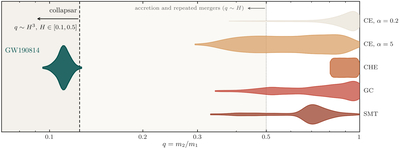
Caption: Figure 1.
Mass ratio of GW190814 compared with predictions from conventional binary-BH formation channels. The teal violin is the GW190814 posterior on q = m2/m1; the right-hand violins show theoretical distributions for common-envelope evolution at efficiencies α = 0.2 and α = 5.0 (CE), chemically homogeneous evolution (CHE), globular-cluster dynamics (GC), and stable mass transfer (SMT). The shaded band at the left marks the collapsar-disk window q ∈ [0.001, 0.125], corresponding to q ∼ H3 for disk scale heights H ∈ [0.1, 0.5]; the dotted line at q ∼ H indicates the broader range available to mergers involving BHs or hierarchical-merger remnants. GW190814 lies inside the collapsar window and is separated from every conventional channel, all of which prefer q ≳ 0.5. Violins show 99% credible intervals; channel distributions are adapted from M. Zevin et al. (2020).
Other Images in This Article
Copyright and Terms & Conditions
© 2026. The Author(s). Published by the American Astronomical Society.

