

Image Details
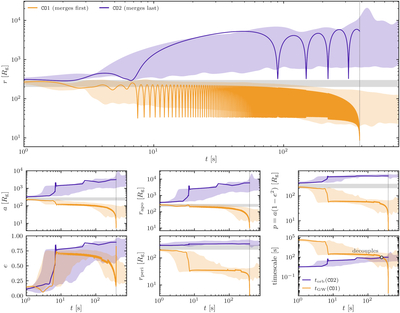
Caption: Figure 2.
A representative realization of the surviving-companion family (solid lines), with 5th–95th percentile bands over the ensemble of such realizations. CO1 (orange) plunges into the BH first; CO2 (purple) survives and is the GW190814 progenitor. Top panels: distance from the BH. Bottom panels: orbit-averaged semimajor axis, eccentricity, apocenter, pericenter, semilatus rectum p = a(1 − e2), and the two competing timescales, the orbital period of CO2 and the GW inspiral time of CO1. The gray band marks the birth annulus [200, 300] Rg. Within a few orbits, the conjunctions raise the semimajor axis of CO2 to a ≳ 103 Rg and its eccentricity to e ≈ 0.8–0.9, while its pericenter remains at the birth radius and its semilatus rectum remains near ﹩9\bar{a}/4﹩ (Equation (6)). CO1 reaches a semimajor axis near ﹩\bar{a}/2﹩ semilatus rectum ﹩\bar{a}/4﹩. The exchange terminates when tGW(CO1) drops below torb(CO2) (Equation (5)) and CO1 plunges (dotted line).
Other Images in This Article
Copyright and Terms & Conditions
© 2026. The Author(s). Published by the American Astronomical Society.

