

Image Details
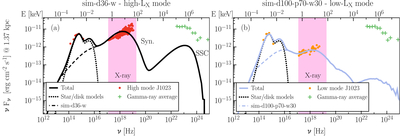
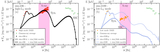
Caption: Figure 4.
Composite SEDs of our models, dominated by the GRMHD contribution in X-rays, show qualitative agreement with the multiwavelength spectra of low- and high-LX modes. Optical to gamma-ray spectral energy distributions are shown from sim-d36-w corresponding to 100% wind regime in the lower-density run, which we attribute to the high mode (panel (a)), and from sim-d100-p70-w30 corresponding to 70% propeller and 30% wind regimes in the higher-density run, which we attribute to the low mode (panel (b)). Contributions include the time-averaged GRMHD (dashed), optical companion, and thermal thin-disk models (dotted). We fixed the density normalization to fit the 0.5–10 keV flux of the high mode (Section 3). For the sim-d36-w model, we indicate the dominant emission mechanism contributing to different parts of the SEDs, synchrotron and synchrotron self-Compton. X-ray data (orange/red dots) and gamma-ray data (green pluses; averaged over both modes) for PSR J1023+0038 are taken from M. C. Baglio et al. (2023) and A. Papitto et al. (2019), respectively, and plotted for comparison. The X-ray band (0.5–80 keV) is shown in pink.
Other Images in This Article
Copyright and Terms & Conditions
© 2026. The Author(s). Published by the American Astronomical Society.

