

Image Details
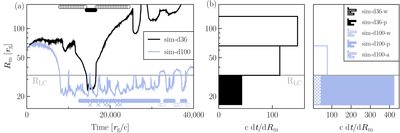
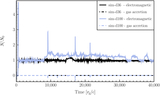
Caption: Figure 2.
The time evolution (a) and histogram (b) of the magnetospheric radius, Rm, show bimodality with respect to the light cylinder radius, RLC, and the main accretion regime depends on the initial density of the torus. (a) In the sim-d100 model (light blue) Rm lies mainly between Rco ≃ 10rg (located outside the plotted range) and RLC ≃ 33rg. In the sim-d36 model (black), the pulsar wind pushes the flow out of RLC most of the time. (b) Histogram showing the time spent for each binned value of Rm and its link to the accretion regime, denoted “w” for “wind,” “p” for “propeller,” and “a” for transient accretion columns (or simply “accretor”), among the epochs covered by our GRMONTY postprocessing step. The instantaneous times of each postprocessed GRMHD snapshot are indicated by the small boxes in panel (a), where we follow the same legend as in panel (b): filled symbols for propeller, empty symbols for wind, and crosses for accretor.
Other Images in This Article
Copyright and Terms & Conditions
© 2026. The Author(s). Published by the American Astronomical Society.

