

Image Details
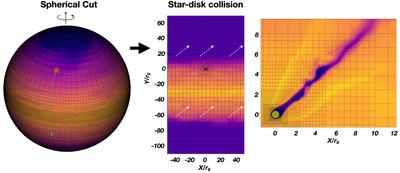
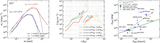
Caption: Figure 1.
Schematic illustration of the procedures adopted in this work. (Left) A spherical shell at 50 rg is extracted from the sub-Eddington accretion-disk simulation of Y.-F. Jiang et al. (2019) (AGN 0.2 run). The red dot and green curve mark the trajectory of a star crossing the disk. (Middle) The sphere is unfolded onto a Cartesian X–Y-plane. All hydrodynamic quantities are spatially smoothed to suppress grid-scale fluctuations, yielding the initial disk profile used in our simulations. The smoothed disk structure is used as input for 2D radiation-hydrodynamic (RH) simulations of a star–disk collision. The disk is initialized moving toward the star, which is treated as a rigid solid sphere (black point). Mesh refinements with five additional levels have been adopted toward the star. (Right) The gas density structure as the star approaches the disk midplane is shown alongside the simulation grid. Each displayed grid cell represents 8 × 8 computational cells.
Other Images in This Article
Copyright and Terms & Conditions
© 2026. The Author(s). Published by the American Astronomical Society.

