

Image Details
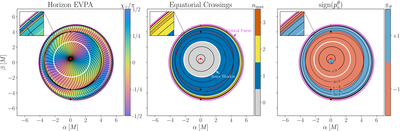
Caption: Figure 1.
The horizon EVPA, equatorial lensing structure, and sign of the outgoing polar momentum at the horizon for a Kerr black hole with spin a* = 0.9375 viewed at inclination θo = 20 deg. Left: The horizon EVPA χ+ plotted in a cyclic colormap; integrated streamlines following the EVPA are overplotted in black. Center: The number of equatorial crossings n made by null geodesics arriving at the observer screen. Contours of constant polar angle θs on the horizon are shown in solid black lines for the northern hemisphere (θs < π/2) and dashed black lines for the southern hemisphere (θs > π/2). For θs < π − θo these contours are closed circles; for θs > π − θo they become banana-like shapes enclosing the image of the poles. Right: The sign of the polar momentum of the outgoing null geodesic sign﹩({p}_{{\rm{s}}}^{\theta })﹩ at the horizon, which enters into the equation for the horizon EVPA (Equation (31)). Red contours indicate boundaries where the sign of the outgoing polar momentum at the horizon switches when Θ(θs) = 0. All panels: The outer magenta contours indicate the critical curve, and white contours indicate successive images of the intersection of the event horizon with the equatorial plane. Successive images of the black hole’s north and south poles are indicated by black and red dots. Insets in the top left show a zoomed-in view of the n = 1 and n = 2 photon ring structure.
Other Images in This Article
Copyright and Terms & Conditions
© 2026. The Author(s). Published by the American Astronomical Society.

