

Image Details
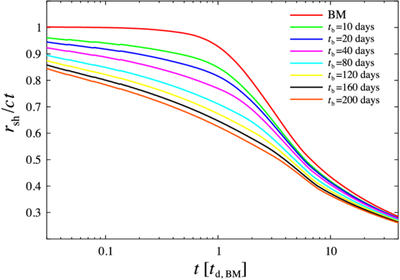
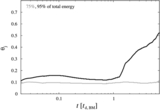
Caption: Figure 3.
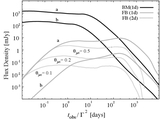
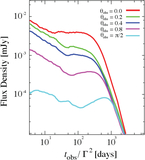
Evolution of the mean forward shock velocity, 〈βsh〉 = rsh/ct, for one-dimensional impulsive and continuously powered blast waves with the same isotropic-equivalent energy, Eiso = 4 × 1053 erg. The impulsive model (BM) is initialized using the Blandford–McKee self-similar solution, while the powered models assume constant energy injection for t < tb, followed by the canonical fallback decay Lj ∝ t−5/3. The circumnuclear medium corresponds to a 107 M⊙ black hole (Figure 1). Increasing the duration of energy injection systematically reduces the shock velocity because, at any given time, only a fraction of the eventual explosion energy has been transferred to the blast wave. Once the bulk of the energy has been injected, the powered solutions gradually converge toward the impulsive evolution.
Other Images in This Article
Copyright and Terms & Conditions
© 2026. The Author(s). Published by the American Astronomical Society.

