

Image Details
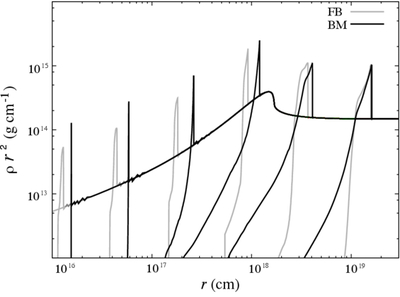
Caption: Figure 2.
Evolution of the radial density profiles for one-dimensional continuously powered (gray) and impulsive (black) blast waves with the same isotropic-equivalent energy, Eiso = 4 × 1053 erg. Profiles are shown at t = 6, 22.7, 103, 691, 4618, and 30,902 days. The powered model (FB) is driven by the fallback-powered luminosity history corresponding to a 107 M⊙ black hole (Figure 1), while the impulsive model (BM) is initialized using the Blandford–McKee self-similar solution (R. D. Blandford & C. F. McKee 1976). At early times, continuous energy injection produces a broader shocked region and prevents the formation of the thin shell characteristic of the impulsive solution. As the blast wave accumulates its final energy, the two solutions gradually converge, although the powered blast wave retains a systematically lower shock velocity throughout the energy injection phase.
Other Images in This Article
Copyright and Terms & Conditions
© 2026. The Author(s). Published by the American Astronomical Society.

