

Image Details
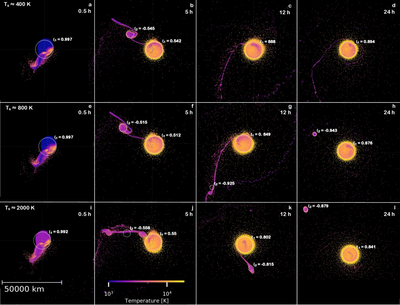
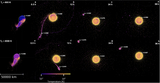
Caption: Figure 2.
Final state of three identical Moon-forming simulations with different initial temperature profiles, from cold to hot: Tsurf ≈ 400 K (top row), Tsurf ≈ 800 K (middle row), and Tsurf ≈ 2000 K (bottom row), with strength included, shown at t = 0.5, 5, 12, and 24 hr. Colors represent temperature (see color bar). When the colliding bodies are fully cooled, Theia remains largely intact after the impact ((a)–(b)), causing the bulk of the impactor to recollide, with a small fraction (∼2%) remaining in a debris disk ((c)–(d)), similar to strengthless scenarios. As the colliding bodies gradually increase in temperature, enhanced deformation of Theia ((e)–(f)) produces a small remnant satellite ((g)–(h)) that struggles to remain intact during subsequent tidal interactions with the proto-Earth (see Appendix D). When the colliding bodies are sufficiently hot, Theia experiences global deformation ((i)), raising torques that split the initial remnant into two ((j)). The outer remnant survives a close tidal encounter with the proto-Earth that drains mass from the satellite to the primary (“walking the dog”; (k)), before stabilizing as an intact satellite ((l)). All simulations performed using 5 × 10⁵ particles. Full animations can be viewed in the Appendix (Figures 7–9).
Other Images in This Article
Copyright and Terms & Conditions
© 2026. The Author(s). Published by the American Astronomical Society.

