

Image Details
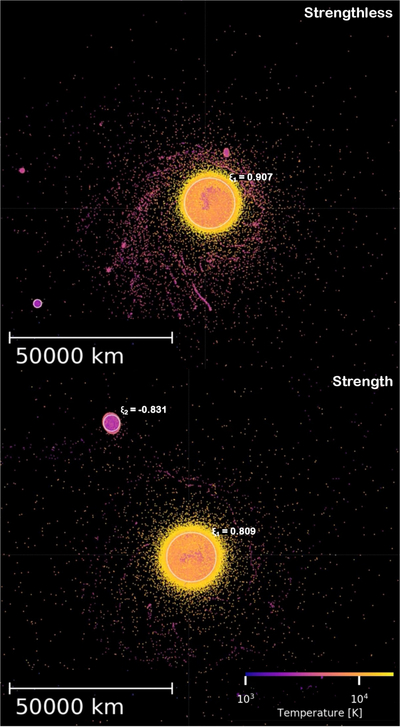
Caption: Figure 1.
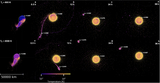
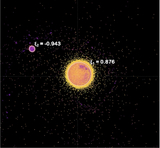
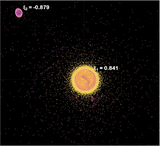
Final state of two identical Moon-forming simulations at 1 M particle resolution, (top) without and (bottom) with strength, for identical initial temperature structures: hot (∼2000 K) but mostly solid. The proto-Earth is 0.877M⊕, and Theia is 0.133M⊕ (see Section 2). Impact angle is θcoll = 45∘, the most probable, and impact velocity is vcoll/vesc = 1 (see Table 1 for other analyzed scenarios). The fluid collision (top) results in the accretion of 91% of Theia and production of a debris disk, nothing larger than 2% of Theia, consistent with prior studies. The collision with strength (bottom) accretes less of Theia directly (84%) and, in this case, captures an intact Moon mass remnant into orbit. ξ values represent accretion efficiency following A. Emsenhuber et al. (2024), and are calculated for identified massive remnants (white circles).
Other Images in This Article
Copyright and Terms & Conditions
© 2026. The Author(s). Published by the American Astronomical Society.

