

Image Details
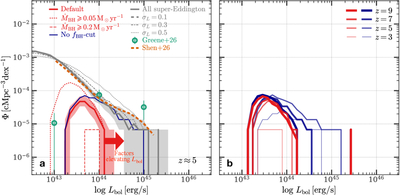
Caption: Figure 4.
Bolometric luminosity function (Φ) of LRDs. (a) Φ of LRDs predicted by our model at z = 5 using the default selection (red solid) and using a number of alternative selections adapted from the default one (see Section 2.2): varying the thresholds of ﹩{\dot{M}}_{{\rm{BH}}}﹩ (red dashed, dotted, and dashed–dotted); removing the fBH threshold (blue; i.e., by additionally including the blue points in Figure 1); retaining only the super-Eddington requirement (gray solid; labeled “All super-Eddington”). We also show the predictions for all super-Eddington BHs by adding log-normal scatter with different widths to their Lbol (gray dashed, dashed–dotted, and dotted). In each case, the curve represents the median, and shading (for the default and all super-Eddington cases) represents the 16th–84th percentile range among 100 random samples for the durations of nuclear bursts. For comparison, we show the results from the literature: the observed LRDs at z = 4–6 with a new bolometric correction (J. E. Greene et al. 2026; green); the LRDs modeled by an empirical mapping from the BHs in the LUMINA simulation (X. Shen et al. 2026; orange). The prediction for Φ is subject to uncertain factors that may elevate Lbol, as indicated by a red arrow (see the Appendix for discussion). (b) Φ of LRDs predicted by our model at different redshifts, using the default selection (red) and the selection without the fBH threshold (blue).
Other Images in This Article
Copyright and Terms & Conditions
© 2026. The Author(s). Published by the American Astronomical Society.

