

Image Details
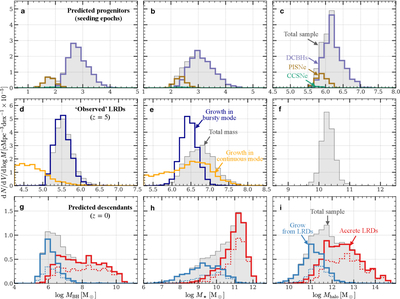
Caption: Figure 3.
Distribution of properties of LRDs as well as their progenitors and descendants. Here the LRDs are those observable at a time slice of z = 5 selected by the default criterion (see Section 2.2 and Figure 1), and their progenitors and descendants are identified through their merger trees. One hundred random samples for the durations of nuclear bursts (see Section 2.2) are drawn and averaged to suppress the sampling noise. The properties shown are MBH of the BH, M⋆ of the host galaxy, and Mhalo of the host halo. For satellites, Mhalo takes the infall value. The distributions are defined as the number of objects per unit comoving volume per unit logarithmic interval of mass and are shown at three stages of their evolution: (a)–(c) the seeding epochs (mostly z ≳ 20; identified backward in time through the main branch of merger tree); (d)–(f) the “observed” epoch (z = 5); and (g)–(i) the present day (z = 0; identified forward in time through descendant chain of merger tree). At seeding, subpopulations of seeds formed via DCBH, PISN, or CCSN are shown in total or separately. At z = 5, we show the distributions of the total mass and of those contributed by the bursty and continuous modes separately, obtained by accumulating the growth of each object in each mode during all snapshots until z = 5 (for example, all previous nuclear bursts are counted in the contribution of the bursty mode to an object identified at z = 5). At z = 0, we show the total sample of descendants and subpopulations according to how an LRD is connected to its descendant: one includes descendants that grew from LRDs (i.e., LRDs lie on their main branches); the other includes descendants that accreted LRDs through mergers (i.e., LRDs lie on their side branches). Within each subpopulation at z = 0, the subset of descendants that are central galaxies is also indicated (dashed). These archaeological and futurological views pinpoint the venues for the progenitors and descendants of LRDs to be found in observations (see Section 3.2 for details).
Other Images in This Article
Copyright and Terms & Conditions
© 2026. The Author(s). Published by the American Astronomical Society.

