

Image Details
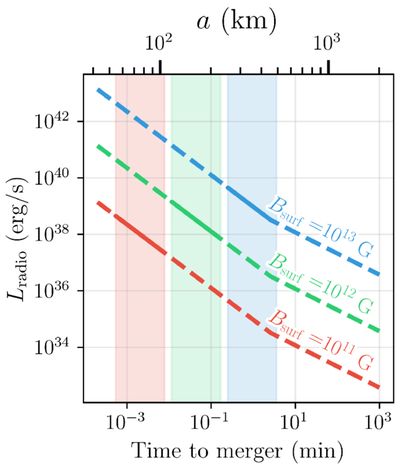
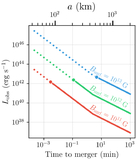
Caption: Figure 7.
Radio luminosity as a function of time to merger (bottom) or orbital separation (top), for three different surface magnetic field strengths (Bsurf = 1011 G, 1012 G, 1013 G in red, green, and blue, respectively). The shaded regions correspond to times in which plasmoid mergers in the trailing current sheet would emit coherent radio waves in the frequency range 400 MHz−8 GHz, for each surface magnetic field strength. The luminosity curves are dashed when the emitted frequency is outside of that frequency range; to the left of the shaded regions, the frequency is higher than 8 GHz and to the right it is lower than 400 MHz. The break at a ∼ 450 km marks the transition from twist provided by stellar spin (L ∝ a−3) to twist provided by the orbital motion (L ∝ a−9/2) for a typical stellar period of P ∼ 0.1 s (see Section 4.1).
Other Images in This Article
Copyright and Terms & Conditions
© 2026. The Author(s). Published by the American Astronomical Society.

