

Image Details
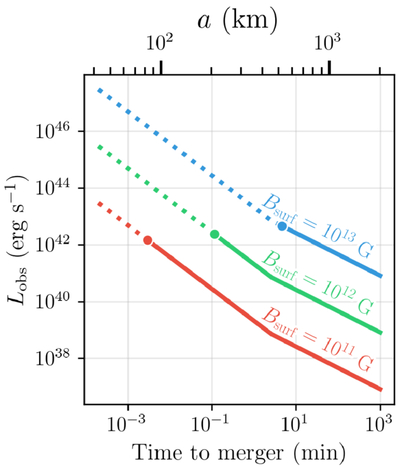
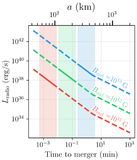
Caption: Figure 6.
Observed gamma-ray luminosity for a head-on observer as a function of time to merger (bottom) or orbital separation (top), for three different surface magnetic field strengths (Bsurf = 1011 G, 1012 G, 1013 G in red, green, and blue, respectively). The dots mark the times at which the sheet ceases to be optically thin to pair production (τγγ ∼ 1). To the right of the dots (solid curves), the nonthermal gamma-ray burst, peaking at ∼16 MeV, would be able to escape. To the left of the dots (dotted curves), the emission becomes optically thick and is Comptonized into a thermal X-ray signal of lower luminosity than Lobs, since the emission would no longer be geometrically beamed. The break at a ∼ 450 km marks the transition from twist provided by stellar spin (L ∝ a−3) to twist provided by the orbital motion (L ∝ a−9/2) for a typical stellar period of P ∼ 0.1 s (see Section 4.1).
Other Images in This Article
Copyright and Terms & Conditions
© 2026. The Author(s). Published by the American Astronomical Society.

