

Image Details
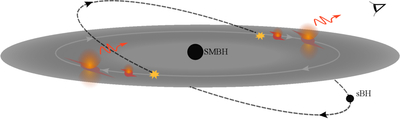
Caption: Figure 1.
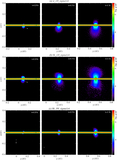
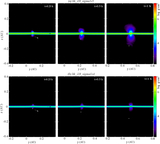
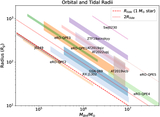
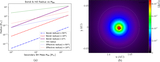
Schematic illustration of an EMRI system, where an sBH moves along a low-inclination orbit and penetrates an optically thick accretion disk with a relative velocity below the local Keplerian speed. During each orbital period, the sBH impacts the disk twice, exciting nearly symmetric ejecta in the vertical directions. The ejecta subsequently expand and cool, evolving into optically thin bubbles through which radiation can escape. Meanwhile, strong gravitational perturbations induce local spiral-shaped density waves in the disk material.
Other Images in This Article
Copyright and Terms & Conditions
© 2026. The Author(s). Published by the American Astronomical Society.

Copyright ©
2026 Astronomy Image Explorer. All Rights Reserved.
