

Image Details
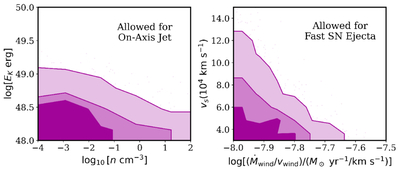
Caption: Figure 5.
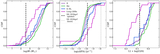
Constraints on models for synchrotron emission from an on-axis top-hat jet expanding into an ISM-like environment (left) and fast SN ejecta interacting with a wind-like CSM (right) from our radio upper limits. Contours show the 50%, 68%, and 90% probability regions. The radio limits constrain an on-axis jet to EK,iso ≲ 1049 erg for typical massive-star environments (n > 10−2 cm−3) and imply low circumstellar mass loading, with fast-ejecta models favoring ﹩{\mathrm{log}}_{10}[(\dot{M}/{v}_{w})/({M}_{\odot }\,{{\rm{yr}}}^{-1}/{\rm{km}}\,{{\rm{s}}}^{-1})]\simeq -7.8﹩
Other Images in This Article
Show More
Copyright and Terms & Conditions
© 2026. The Author(s). Published by the American Astronomical Society.

Copyright ©
2026 Astronomy Image Explorer. All Rights Reserved.
