

Image Details
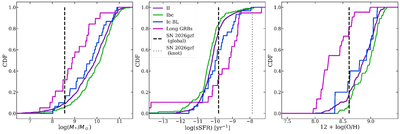
Caption: Figure 10.
The global host-galaxy stellar mass (M*; left), sSFR (middle), and 12+log(O/H) metallicity (right) of SN 2026gzf (black dashed line) compared to the respective CDFs of the hosts of long GRBs (magenta; K. M. Svensson et al. 2010; D. A. Perley & R. A. Perley 2013; F. Y. Wang & Z. G. Dai 2014; Y. Niino et al. 2017), Type Ic-BL (blue), Ibc (green), and II (dark purple) SNe (Y.-J. Qin & A. Zabludoff 2024; A. E. Nugent et al. 2026). We also show the sSFR of the star-forming knot coincident with the location of SN 2026gzf (gray dotted line). The host itself is low mass, low metallicity, and star-forming, with properties that are overall more typical for long GRB hosts than the other transient host populations. The knot is extremely star-forming in comparison to the global host properties and other transient host populations.
Other Images in This Article
Show More
Copyright and Terms & Conditions
© 2026. The Author(s). Published by the American Astronomical Society.

