

Image Details
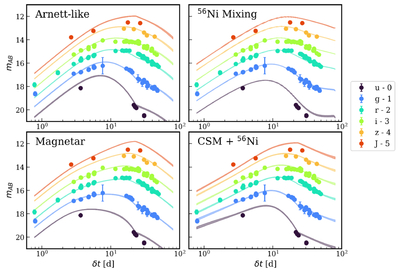
Caption: Figure 9.
We fit the ugrizJ-band light curves of SN 2026gzf with five models in REDBACK (the pure CSM interaction model is not shown here as it requires infeasible Mej and EK; Section 4.4.4). We disfavor the one-zone Arnett-like, magnetar, and pure CSM interaction models because they either provide poor statistical fits or require nonphysical parameters (Sections 4.4.1, 4.4.3, and 4.4.4). The combined CSM+56Ni model is our preferred model. Relative to the 56Ni mixing model, the constrained CSM+56Ni fit improves the Bayesian evidence by ﹩{\rm{\Delta }}\mathrm{ln}Z\simeq 47﹩.
Other Images in This Article
Show More
Copyright and Terms & Conditions
© 2026. The Author(s). Published by the American Astronomical Society.

Copyright ©
2026 Astronomy Image Explorer. All Rights Reserved.
