Image Details

Choose export citation format:

A Multiwavelength View of the First Type Ic-BL Supernova with an Einstein Probe X-Ray Shock Breakout

  • Authors: Jillian C. Rastinejad, Gokul Srinivasaragavan, Nikhil Sarin, Tanner O'Dwyer, S. Bradley Cenko, James K. Leung, Anya E. Nugent, Daniel A. Perley, Genevieve Schroeder, Shreya Anand, Tomás Ahumada, Igor Andreoni, Aleksandra Bochenek, Alessandra Corsi, Christoffer Fremling, Anna Y. Q. Ho, Mansi M. Kasliwal, Geoffrey Mo, Anirudh Salgundi, Kendall I. Sippy, J. Sollerman, Eric C. Bellm, Tracy X. Chen, Michael W. Coughlin, Michael C. Davis, Fabio De Colle, Danielle Frostig, Christopher L. Fryer, Michael J. Graham, Xander J. Hall, K.-R. Hinds, Luca Izzo, Wynn Jacobson-Galán, Nathan P. Lourie, Keiichi Maeda, Josiah Purdum, Ben Rusholme, Avinash Singh, Robert Stein

Jillian C. Rastinejad et al 2026 The Astrophysical Journal Letters 1007 .

  • Provider: AAS Journals

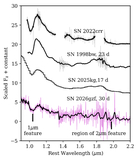
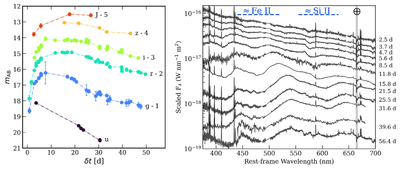
Caption: Figure 2.

Optical observations of the Type Ic-BL counterpart to EP 260321a, SN 2026gzf. Left: our optical and near-IR light curve of SN 2026gzf. Right: sequence of GMOS, SOAR, and NGPS spectra of SN 2026gzf. We mask the regions of the emission lines of Hα, Hβ, and [O II] for visibility. Spectra are not corrected for Galactic extinction, which is weak along the line of sight (E(B V) = 0.02; E. F. Schlafly & D. P. Finkbeiner 2011).

Other Images in This Article
Show More

Copyright and Terms & Conditions

Additional terms of reuse