

Image Details
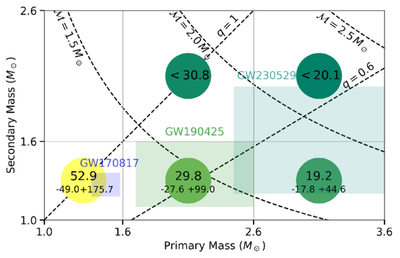
Caption: Figure 2.
BNS and low-mass NSBH rates, in units of Gpc−3 yr−1, inferred from the latest GW catalog, GWTC-4, as a function of their component masses, taking mass bins with edges of 1, 1.6, 2.6 and 3.6 M⊙. For mass ranges at which no mergers have been detected, we report 90% upper limits. For mass ranges that have at least one detection, we report the median and 90% credibility interval. We conservatively count GW230529 in the bin centered at 1.3 + 3 M⊙, although its BH component may be as high as 4.5 M⊙. We assume the mass distribution is uniform in each bin, with a uniform spin distribution up to 0.4 for masses below 2.6 M⊙, and a uniform spin distribution up to 1 for masses above 2.6 M⊙. The joint BNS merger rate (median and 90% credible interval) is ﹩11{0}_{-82}^{+192}{{\rm{Gpc}}}^{-3}\,{{\rm{yr}}}^{-1}﹩. The joint BNS/low-mass NSBH merger rate is ﹩14{7}_{-96}^{+198}{{\rm{Gpc}}}^{-3}\,{{\rm{yr}}}^{-1}﹩.
Other Images in This Article
Copyright and Terms & Conditions
© 2026. The Author(s). Published by the American Astronomical Society.

