

Image Details
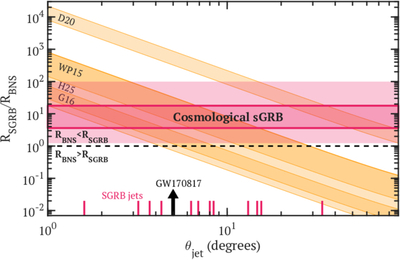
Caption: Figure 4.
Ratio of volumetric rates ﹩{{ \mathcal R }}_{{\rm{SGRB}}}/{{ \mathcal R }}_{{\rm{BNS}}}﹩ versus jet opening angle θjet in degrees, assuming a central value ﹩{{ \mathcal R }}_{{\rm{BNS}}}=100﹩ Gpc−3 yr−1. The orange bands represent local rates (<200 Mpc) inferred from SGRBs (D. Wanderman & T. Piran 2015; G. Ghirlanda et al. 2016; S. Dichiara et al. 2020; E. J. Howell et al. 2025) in which the width of the band is set by the uncertainties in both the BNS and SGRB rates. Also shown are the cosmological SGRB rates inferred from SGRB jet opening angles assuming a local rate of 10 Gpc−3yr−1 (A. Rouco Escorial et al. 2023). We show two ranges: (i) assuming a fixed central value of ﹩{{ \mathcal R }}_{{\rm{BNS}}}=100﹩ Gpc−3 yr−1 (central red band) resulting in a cosmological SGRB rate of ∼3.6–18 times larger than the latest BNS rate, and (ii) incorporating the uncertainties of both the BNS and SGRB rates representing a very conservative and wide range, resulting in a ratio of ∼1.3–100. It is also clear that wider jets of ≳10∘ for most SGRBs would be required to reduce any rate tension, which represents only a minority of SGRB jet opening angles (red lines).
Other Images in This Article
Copyright and Terms & Conditions
© 2026. The Author(s). Published by the American Astronomical Society.

