

Image Details
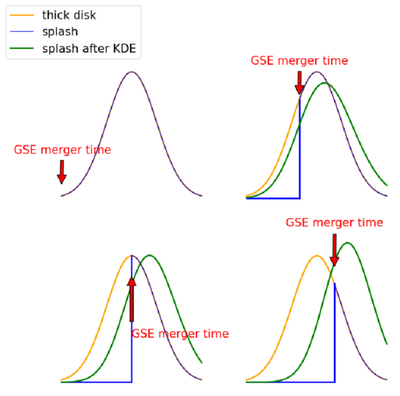
Caption: Figure 4.
Illustration of why the Splash appears older than the thick disk. We assume that the thick-disk star formation history (orange) follows a Gaussian distribution. Prior to the GSE merger, the intrinsic age distribution of Splash stars (blue) is identical to that of the thick disk, but Splash formation is truncated at the merger epoch. The Splash curve therefore drops abruptly at the merger time (blue step). Convolution with Gaussian age uncertainties produces the “observed” Splash distribution (green), in which the peak shifts toward older ages due to the lack of the younger part of the distribution. The four panels show different assumed merger epochs, from top left to bottom right: near the end of thick-disk formation, just after the peak, around the peak, and before the peak. The combination of truncation and age uncertainties makes the Splash appear older than the thick disk.
Other Images in This Article
Copyright and Terms & Conditions
© 2026. The Author(s). Published by the American Astronomical Society.

