

Image Details
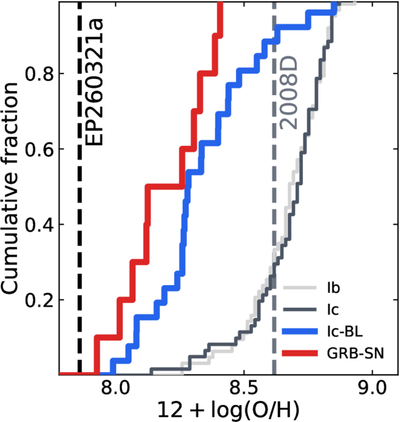
Caption: Figure 17.
Cumulative distribution of oxygen abundances for low-redshift (z < 0.2) SNe Ic-BL without detected GRBs (blue) and GRB-SN Ic-BL events (red), compiled from the PP04 O3N2 (M. Pettini & B. E. J. Pagel 2004) measurements from J. Japelj et al. (2018) and M. Modjaz et al. (2020), and local (z < 0.025) SNe Ib and Ic (gray) from M. Modjaz et al. (2011), R. Ganss et al. (2022, 2025) converted to the PP04 O3N2 scale. The metallicity at the explosion sites of EP260321a and SN 2008D is shown as a dashed vertical line.
Other Images in This Article
Show More
Copyright and Terms & Conditions
© 2026. The Author(s). Published by the American Astronomical Society.

Copyright ©
2026 Astronomy Image Explorer. All Rights Reserved.
