

Image Details
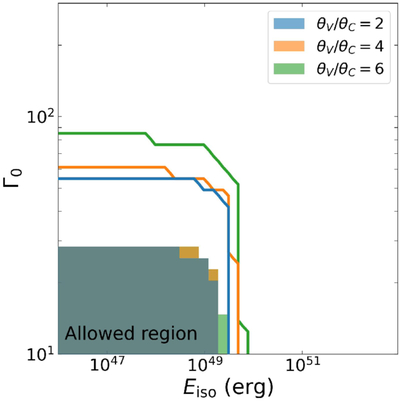
Caption: Figure 12.
Allowed parameter space (shaded regions) of initial Lorentz factor Γ0 at the jet’s core and the jet’s core kinetic energy Ekin for afterglow nondetection, assuming a Gaussian-structured jet at 158 Mpc (z = 0.0344) based on the available X-ray and radio upper limits. In a wind environment, the allowed parameter space is weakly dependent on the viewing angle θv/θc. We have fixed θc = 0.15 rad, A* = 1, εe = 0.1, εB = 0.01, and p = 2.2. As an example of the impact of decreasing density, we show the allowed parameter space for A* = 0.1 as solid lines (see also Figure 18 in Appendix B).
Other Images in This Article
Show More
Copyright and Terms & Conditions
© 2026. The Author(s). Published by the American Astronomical Society.

Copyright ©
2026 Astronomy Image Explorer. All Rights Reserved.
