

Image Details
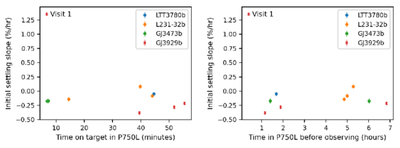
Caption: Figure 14.
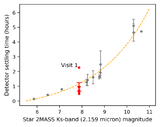
We compare the size of the detector-settling slope (defined by fitting a linear slope to the first 30 minutes of data) to the length of time spent with the P750L filter prior to switching to F1500W, both on target (left) and in total (right), for the four eclipses of GJ 3929 b and the relevant targets of the Hot Rocks Survey described in M. Fortune et al. (2025). We find that all but one visit of GJ 3929 b have detector-settling slopes similar to the other previously observed targets. The discrepant visit of GJ 3929 b spends a similar amount of time on target with P750L to two visits of a previous target, GJ 3473b, yet it does not have a homogenized slope. If we consider the total length of time with P750L before the telescope has finished slewing to the target, we see that the first visit of GJ 3929 b spends the lowest time overall using this filter as part of the pre-slewing experiment, while all other observations spend over 1 hr in this filter prior to starting.
Other Images in This Article
Show More
Copyright and Terms & Conditions
© 2026. The Author(s). Published by the American Astronomical Society.

