

Image Details
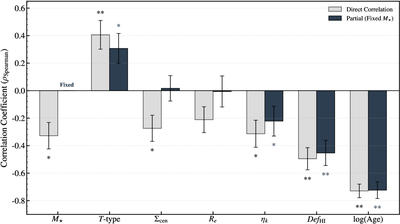
Caption: Figure 3.
Spearman rank correlation coefficients (ρSpearman) between metallicity gradients (∇r[Z/H]) and various galaxy properties. The light gray bars represent the direct (zero-order) correlation coefficients, while the dark blue bars indicate the partial correlation coefficients after controlling for galaxy stellar mass (M⋆). The analyzed properties include stellar mass (M⋆), H I deficiency parameter (DefHI), central stellar mass surface density (Σcen), morphological T type, local projected number density of galaxies (ηk), light-weighted stellar age (﹩\mathrm{log}({\rm{Age}})﹩), and effective radius (Re). Error bars denote the 1σ uncertainties estimated via bootstrap resampling. Statistical significance levels based on the full dataset are indicated above the bars: no asterisks for p ≥ 0.05 (not significant), a single asterisk (∗) for p < 0.05, and double asterisks (∗ ∗ ) for p < 0.001. Notably, stellar age and the H I deficiency parameter maintain statistically significant correlations with the metallicity gradient even after fixing M⋆, whereas morphological and structural parameters show negligible and statistically insignificant partial correlations.
Other Images in This Article
Copyright and Terms & Conditions
© 2026. The Author(s). Published by the American Astronomical Society.

