

Image Details
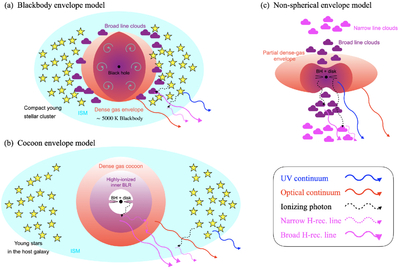
Caption: Figure 1.
Schematic pictures of AGN+dense gas envelope models (also known as BH* models) for LRDs proposed in the literature. (a) K. Inayoshi et al. (2026a) proposed a model where the central BH is enshrouded by a thick gas envelope. Since it is optically thick, no radiation from the AGN accretion can escape, and the envelope is thermalized and observed as a blackbody. In this model, all UV light, narrow lines, and broad lines are powered by young massive stars surrounding the envelope, and the rest-optical continuum is explained by the thermal emission. (b) The cocoon envelope model originally proposed by R. P. Naidu et al. (2025) has a layered cocoon around the central BH. The broad lines originate from the inner layer, which is illuminated by the accretion disk, and leak out after multiple scatterings through the outer layer. The cocoon is optically thick for UV continuum, and the UV light and narrow line in LRDs needs to be emitted from host galaxies. The rest-optical continuum in this model originated either from the Balmer limit photon absorption by the cocoon or from the thermal emission of the cocoon heated by the AGN accretion. (c) When the dense envelope around the central BH is not spherical and is not optically thick toward the polar axis (e.g., X. Lin et al. 2026), all UV light, narrow, and broad lines can be from the AGN accretion. This is similar to the standard AGN picture, but it lacks the dust torus and instead has a nonspherical envelope that emits blackbody thermal emission in the rest optical.
Other Images in This Article
Copyright and Terms & Conditions
© 2026. The Author(s). Published by the American Astronomical Society.

